


Instructional Design Models
Instructional design models help instructional designers to make sense of abstract learning theory and enable real world application. Instructional design models organize and visualize learning theories and principles to guide instructional designers through a learning development process. Stated differently, an instructional design model can be considered a framework to develop learning materials. Many of them have common instructional design principles and patterns. Below is a list of the most common instructional design models (including the ADDIE model) that are used to design learning experiences, courses, and instructional content.

ADDIE Model
The ADDIE Model was first created for the U.S. Military during the 1970s by Florida State University. ADDIE is an acronym for a five-phase course development process. The ADDIE Model generally consists of five interrelated phases—Analysis, Design, Development, Implementation, and Evaluation. The ADDIE Model represents a flexible guideline for building effective training and instructional materials. See each of the phases below:
Analysis
In the analysis phase of the ADDIE Model the instructional problem is identified. The instructional goals, success metrics, and overall objectives are also established. Information regarding the learner such as the learning environment, preferences, demographics, and existing knowledge and skills are also identified during this phase.
Design
The design phase of the ADDIE Model nails down learning objectives, instructional methods and activities, storyboards, content, subject matter knowledge, lesson outlines, and media assets.
Development
The development phase of the ADDIE Model is where instructional designers develop the content and learning interactions outlined in the design phase. During this phase, content is written and graphics, audio, and photography are also produced and assembled.
Implementation
During the implementation part of the ADDIE Model, the instructional designer delivers the content and materials to Learning Management Systems (LMS) or directly to the trainer for live training events. The instructional designer also provides training needed to trainers, facilitators, SME's or instructors.
Evaluation
During the evaluation phase of the ADDIE Model, the instructional designer determines what success will look like and how it will be measured. Often times, the evaluation consists of two phases: formative and summative. Formative evaluation is iterative and is done throughout the design and development processes. This occurs all throughout the ADDIE process. Summative evaluation consists of tests that are done after the training materials are delivered. The results from these test help to inform the instructional designer and stake holders on whether or not the training accomplished its original goals outlined in the analysis phase.

ADDIE Model
SAM Model
"SAM is a different approach to the development of instructional design products that addresses the performance need through iterations, repeated small steps, rather than with perfectly executed giant steps. SAM challenges the notion of moving through a linear process (like ADDIE) from Analysis to Evaluation as an effective strategy for designing learning events intending to produce greater performance. SAM addresses the roadblocks we all face (product quality, meeting timelines and budgets, and managing SMEs). Most importantly, SAM is an agile e-learning development process built specifically for the creation of performance-driven learning. Below are the core phases:
Preparation:
Instead of starting with a long, drawn-out evaluation of the existing or “needed” content, SAM starts with the preparation phase—where you gather information and get all the background knowledge. This is intended to be a very quick phase.
Iterative Design:
This phase begins with the Savvy Start, the initial collaborative brainstorming meeting that establishes the foundation for a successful project. The Savvy Start focuses primarily on performance and will serve as the project kickoff meeting and the main environment for all project team members to converse. Throughout the Savvy Start and the Iterative Design Phase, your team will be rotating through design, prototype, and review.
Iterative Development:
Much like the Iterative Design Phase, in the Iterative Development Phase your team will rotate through development, implementation, and evaluation. You’ll start with your design proof, moving to Alpha and Beta, before finally rolling out the Gold. As the instructional product is being developed, you continually analyze and evaluate, so that at any point if a change needs to occur, it can happen quickly and limit any risk of the project moving out of budget or time." Source: www.alleninteractions.com

SAM Model
Action Mapping
"Action Mapping is a quick, effective, and visual way to design compelling learning experiences for instructional products including eLearning, simulations, and in person training events. It is called action mapping because it helps change what people do, not just what they know. It helps to design action-packed materials that are 100% dedicated to improving business performance. Additionally, it can keep stakeholders from adding extraneous information." Source: www.blog.cathy-moore.com
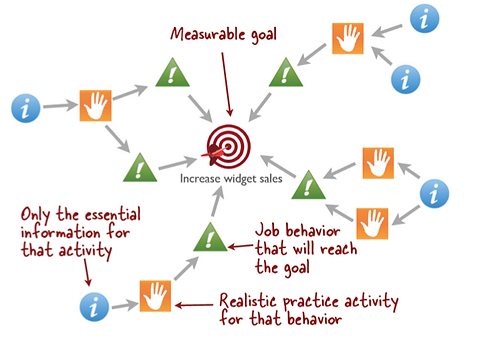
Cathy Moore's Action Mapping
Are you looking for a simple and modern learning design model that meets the needs of todays fluid workforce? Instructional Design Central (IDC) has created a three phase, easy-to-follow framework to rapidly build and present your learning design strategy—we call this The Learning Circle Framework™. The Learning Circle Framework™ is founded on modern learning design and product development principles. See an overview of The Learning Circle Framework™


Merrill's First Principles of Instruction
"Many current instructional design models suggest that the most effective learning environments are those that are problem-based and involve the student in four distinct phases of learning: (1) activation of prior experience, (2) demonstration of skills, (3) application of skills, and (4) integration or these skills into real world activities. Figure 2 below illustrates these five ideas. Much instructional practice concentrates primarily on phase 2 and ignores the other phases in this cycle of learning."

Merrill's First Principles of Instruction
At the top level the instructional design prescriptions based on first principles are as follows:
-
Learning is facilitated when learners are engaged in solving real-world problems.
-
Learning is facilitated when existing knowledge is activated as a foundation for new knowledge.
-
Learning is facilitated when new knowledge is demonstrated to the learner.
-
Learning is facilitated when new knowledge is applied by the learner
-
Learning is facilitated when new knowledge is integrated into the learner's world." Source: www.mdavidmerrill.com
Gagné's 9 Events of Instruction
"Robert Gagné is considered to be the foremost contributor to the systematic approach to instructional design and training. Gagne and his followers are known as behaviorists, and their focus is on the outcomes (or behaviors) resulting from training.
Gagné's book, The Conditions of Learning, identified the mental conditions for learning. Gagné created a nine-step process called the events of instruction, which correlate to and address the conditions of learning. See the nine events of instruction below: Source: www.edutechwiki.unige.ch

Gagné's 9 Events of Instruction
Bloom's Taxonomy
"In 1956, Benjamin Bloom headed a group of educational psychologists who developed a classification of levels of intellectual behavior important in learning. Bloom found that over 95 % of the test questions students encounter require them to think only at the lowest possible level...the recall of information.
Bloom identified six levels within the cognitive domain, from the simple recall or recognition of facts, as the lowest level, through increasingly more complex and abstract mental levels, to the highest order which is classified as evaluation. Verb examples that represent intellectual activity on each level are listed here.

Bloom's Taxonomy
-
Knowledge: arrange, define, duplicate, label, list, memorize, name, order, recognize, relate, recall, repeat, reproduce state.
-
Comprehension: classify, describe, discuss, explain, express, identify, indicate, locate, recognize, report, restate, review, select, translate,
-
Application: apply, choose, demonstrate, dramatize, employ, illustrate, interpret, operate, practice, schedule, sketch, solve, use, write.
-
Analysis: analyze, appraise, calculate, categorize, compare, contrast, criticize, differentiate, discriminate, distinguish, examine, experiment, question, test.
-
Synthesis: arrange, assemble, collect, compose, construct, create, design, develop, formulate, manage, organize, plan, prepare, propose, set up, write.
-
Evaluation: appraise, argue, assess, attach, choose compare, defend estimate, judge, predict, rate, core, select, support, value, evaluate." Source: www.en.wikipedia.org
"During the 1990's a new group of cognitive psychologists, lead by Lorin Anderson (a former student of Bloom), updated the taxonomy to reflect relevance to 21st century work. The new taxonomy includes a higher level cognitive performance titled 'Create.'" Source: www.celt.iastate.edu/


Dick and Carey Model
"Another well-known instructional design model is The Dick and Carey Systems Approach Model. The model was originally published in 1978 by Walter Dick and Lou Carey in their book entitled The Systematic Design of Instruction.
Dick and Carey made a significant contribution to the instructional design field by championing a systems view of instruction as opposed to viewing instruction as a sum of isolated parts. The model addresses instruction as an entire system, focusing on the interrelationship between context, content, learning and instruction. According to Dick and Carey, "Components such as the instructor, learners, materials, instructional activities, delivery system, and learning and performance environments interact with each other and work together to bring about the desired student learning outcomes". The components of the Systems Approach Model, also known as the Dick and Carey Model, are as follows:
-
Identify Instructional Goal(s): goal statement describes a skill, knowledge or attitude(SKA) that a learner will be expected to acquire
-
Conduct Instructional Analysis: Identify what a learner must recall and identify what learner must be able to do to perform particular task
-
Analyze Learners and Contexts: Identify general characteristics of the target audience including prior skills, prior experience, and basic demographics; identify characteristics directly related to the skill to be taught; and perform analysis of the performance and learning settings.
-
Write Performance Objectives: Objectives consists of a description of the behavior, the condition and criteria. The component of an objective that describes the criteria that will be used to judge the learner's performance.
-
Develop Assessment Instruments: Purpose of entry behavior testing, purpose of pretesting, purpose of posttesting, purpose of practice items/practice problems
-
Develop Instructional Strategy: Pre-instructional activities, content presentation, Learner participation, assessment
-
Develop and Select Instructional Materials
-
Design and Conduct Formative Evaluation of Instruction: Designer try to identify areas of the instructional materials that are in need of improvement.
-
Revise Instruction: To identify poor test items and to identify poor instruction
-
Design and Conduct Summative Evaluation
With this model, components are executed iteratively and in parallel rather than linearly." Source: http://en.wikipedia.org

Dick and Carey Model
Kemp's Instructional Design Model
"The Jerold Kemp instructional design method and model defines nine different components of an instructional design and at the same time adopts a continuous implementation/evaluation model. Kemp adopts a wide view, the oval shape of his model conveys that the design and development process is a continuous cycle that requires constant planning, design, development and assessment to insure effective instruction. The model is systemic and nonlinear and seems to encourage designers to work in all areas as appropriate (Steven McGriff). The model is particularly useful for developing instructional programs that blend technology, pedagogy and content to deliver effective, inclusive (reliable) and efficient learning. According to McGriff, Kemp identifies nine key elements:
-
Identify instructional problems, and specify goals for designing an instructional program.
-
Examine learner characteristics that should receive attention during planning.
-
Identify subject content, and analyze task components related to stated goals and purposes.
-
State instructional objectives for the learner. Sequence content within each instructional unit for logical learning.
-
Design instructional strategies so that each learner can master the objectives.
-
Plan the instructional message and delivery.
-
Develop evaluation instruments to assess objectives.
-
Select resources to support instruction and learning activities." Source: www.edutechwiki.unige.ch

Kemp Instructional Design Model
Kirkpatrick's Four Levels of Training Evaluation
"The Kirkpatrick Model is the worldwide standard for evaluating the effectiveness of training. It considers the value of any type of training, formal or informal, across four levels.
-
Level 1 Reaction evaluates how participants respond to the training.
-
Level 2 Learning measures if they actually learned the material.
-
Level 3 Behavior considers if they are using what they learned on the job.
-
Level 4 Results evaluates if the training positively impacted the organization.
Created by Dr. Don Kirkpatrick in the 1950s, the model is applied before, during and after training to both maximize and demonstrate training's value to the organization." Source: http://www.kirkpatrickpartners.com

Kirkpatrick's Four Levels of Training Evaluation
Design Thinking
Design Thinking is an iterative design process, with ideation and testing that provides a solution-based approach to solving problems. It could also be considered more of a philosophy or an approach towards developing a solution. It centers around a focused interest in developing an understanding of the learners for whom we are designing and developing learning products. Design Thinking was originally targeted towards User Experience UX design or Interaction Design, but the patterns and principles are very similar to the that of Learning Experience Design (LXD). Design Thinking is less focused on delivering learning specific and pre-prescribed learning outcomes, and more focused on delivering a learning experience that meets his or her needs or preferences.
